
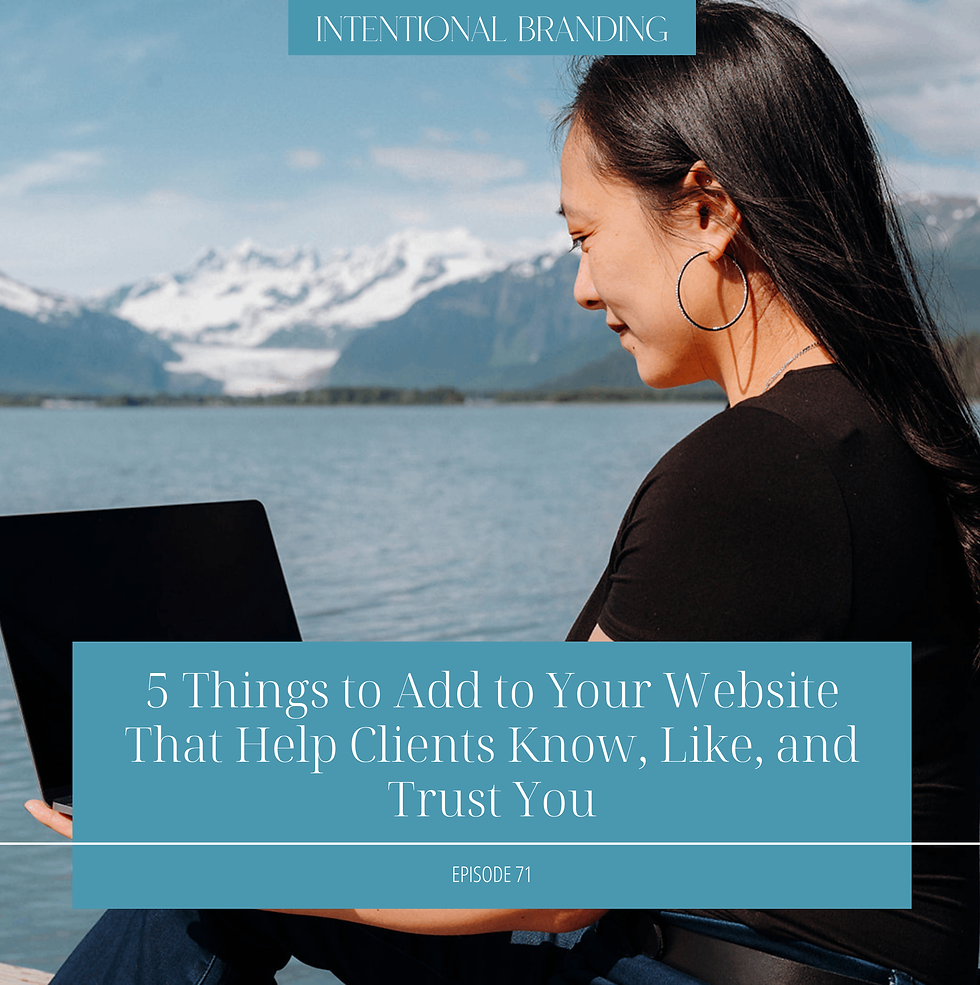
5 Things to Add to Your Website That Help Clients Know, Like, and Trust You - Ep. 71

Prefer to listen?
This article is adapted from an episode of Intentional Branding where I talk through this topic in more detail.
Most of us know the obvious answer to what to include on a website: your services, testimonials, an About page, contact information, calls to action, FAQs, and maybe a portfolio or examples of your work.
But having those things on your website doesn't automatically make someone want to work with you.
A strategic website should help a potential customer get to know you, find reasons to like and resonate with you, trust that you can help them, and feel comfortable taking that next step.
So what should a website contain beyond the basics? Here are five things you might not think to include that can make a big difference in how potential customers experience your business. These aren't extras, they're part of your website's main content, the pieces that actually turn visitors into clients.
5 Things to Add to Your Website That Help Clients Know, Like, and Trust You
1. Add Rapport Builders That Let People Get to Know You
If you're a newer business owner wondering how to earn trust and build relationships online, rapport builders are where I'd start. People want to know who they're hiring, especially in a service-based business.
I don't want you to strip all the personality out of your website in an attempt to look professional. I feel like a lot of people do that, and it can make their websites feel cold.
One way to build rapport is by sharing fun facts about yourself. And those fun facts don't need to be random. A helpful tip is to reflect them back to your business.
Let's say you're an artist. You could share that you love the outdoors, the mountains, nature, or water, and then connect those things back to what inspires your artwork.
There's a reason why we find each other's lives so interesting. Every human is unique, and getting little glimpses into someone's life creates a connection. It almost feels like you know that person.
The same should be true of your company website. People should land on your website and feel like they know you.
I'm not saying you should put your whole life story on there. You just need to give people something they can grab onto and think, "Ooh, I like her," or, "Me too," or, "I relate to that."
For me, I talk about how I grew up doing art classes. I loved art classes in elementary school, always took them as an elective in middle school, then did it again in high school and college. That really ties together with me being a graphic designer.
I've been creative my whole life.


Those little details help potential clients understand the person behind the business, and they can become the reason someone feels connected to you.
In fact, when I ask my clients, "What made you want to hire me?" about 70% of the people who answer mention something from my About page. Maybe they connected with my journey, the fact that I went on exchange in Australia, or even that I have two bunnies.
You don't need to share your entire life story. Just sprinkle a little bit of yourself into your About page.
That's where the know factor comes in.
2. Share Values That Show What It's Like to Work With You
Your values aren't just things like mission statements. They can show potential clients what it will actually be like to work with you.
My business values are strategic, intentional, and simple. Those are the three words I want my ideal clients to connect with because they're things they're looking for in design.

Strategic means I want my designs to have a purpose and help with conversion, whether that's on a website or a marketing poster.
Intentional means every piece of text or graphic is there for a reason. If I'm putting an interesting shape behind an important piece of text, there's an intention and strategy behind that choice. I want people's eyes to go toward the information that matters.
And then there's simple.
A lot of people come to me saying they don't want something overly designed. They want something clean and easy to use. That goes all the way back to simple.
I like to put three values on a website. Three is kind of a good number for a lot of things, like three values or three services. I wouldn't go beyond that because it can be overwhelming for the visitor.
Whatever your values are, share them.
When your values are clear, potential clients can recognize what matters to you and decide whether those same things matter to them.
3. Give Your Website a Point of View, Not Just Information
Go beyond telling visitors what you do and tell them what you believe about the work you do.
For example:
"I don't believe a website should just look pretty. It should make it easier for the right client to understand why you're the right fit."
This is where brand strategy can really show up in the copy, not only visually. Your website can communicate how you think and why you make the choices you make.
A strong point of view gives the right visitor another opportunity to think, "Yes, that is exactly what I believe and want to believe as well."
It also helps you differentiate yourself.
For example, I'm currently creating a website for a massage therapist who's not just an average massage therapist. She wants to bring in things like bodywork and Ayurvedic practices with oils, and warming dough.
That needs to speak to the right people.
She's looking for a unique client who isn't just looking for massage therapy, but someone who wants to heal their body as a whole. That's her point of view.
Her website needs to communicate that understanding so the right person can land there and think, "Okay, she understands that my body's hurting right now, and she can take the weight off."
That's a powerful way to differentiate yourself from one business to another.
For my website, I'm not just telling people I'm better than other designers. My philosophy, how I think, and the process I use for my design are all going to help the right person decide if we're a good fit.
And sometimes, your point of view will naturally filter people out.
I had someone earlier this year who didn't want to work with me because I sent them a booking link to get on a discovery call. That threw him off. He didn't want to do that, so he sent me a text saying he didn't want to work with me.
And I thought, "Oh, okay. I mean, ouch." But that's okay.
Maybe his point of view is more about working with a client one-on-one and having a specific meeting place and time. That's just not my ideal client, and that's totally fine.
Your website doesn't need to appeal to everyone. It needs to help the right people recognize themselves in how you think and work.
4. Set Expectations Before Someone Has to Ask You
Think about everything someone might need to know to feel comfortable taking the next step.
I'm not just talking about standard logistical FAQs.
If people are always asking you a certain question when they inquire, consider whether you can answer it directly on your website.
For example, if people are always asking, "How much do your packages cost?" put your prices on your website.
I know there's skepticism about having your prices on your website. But think about it from the customer's perspective.
Imagine walking into a store where there are no prices. You have to ask a sales attendant every single time, "Hey, how much is this?"
That's annoying because you don't know if you can afford it.
The same thing applies to services.
Even if you don't publish your exact prices, put your starting prices or some kind of range on your website. That helps people know if they're in the right place before booking a call.
You don't want someone to hop on a call when your price is $5,000 for social media and their budget is $200. That's a waste of time for both of you.
But expectations aren't only about pricing.
A food tour might need to explain the duration, number of stops, type of food, and what's included.
Someone offering wills and trusts might need to explain the timeline, how everything works, what paperwork is included, and what happens after the initial inquiry.
A community garden might need to explain that, in addition to the annual cost, members need to complete five service hours.
The question I want you to ask yourself is:
What could someone discover later that I can make clear right now by putting it on my website?
It's about setting expectations to reduce uncertainty and build trust, so people know what they're saying yes to.
Think about walking into a physical store. You can touch things, see colors in real life, ask questions, try things on, and get a sense of what you're buying.
Online, you don't have all of that certainty.
With clothing, you might need to know the size, color, material, and what it looks like on someone's body. That's why things like model height, weight, and clothing size can be so helpful. You're trying to picture what the product will look like on you.
With a service, you're trying to picture what it will look like to work with you.
A photographer's clients might wonder:
What happens if I'm awkward in front of the camera?
How much direction will you give me?
How long is the session?
How many photos do I get?
Someone looking for a brand or web designer might wonder:
Exactly what am I getting?
How involved do I need to be?
How many meetings are there?
What do I need to do to prepare?
How long will the project take?
A house cleaning client might wonder:
Do I need to be home?
Do I need to clean before you arrive?
Do you bring supplies?
Are pets okay to be home?
How long will you be there?
Your website should give people enough information to mentally try on the experience before they inquire.
Heres an example from a website I designed for Juneau Local Tours

5. Help Visitors Recognize Whether Your Offer Is or Isn't for Them
If you're asking yourself what you can do so that just by going through your website, people get a clear sense of whether they actually need your services, this section is it.
I don't want you to make your visitors figure out whether they're the right client.
I want you to tell them.
This is where a "This is for you if..." section can really help.
You might say:
This is for you if you're a small business owner who...
Or:
This is for you if you're ready to invest in...
But sometimes, "This is not for you if..." can be helpful too. It prevents someone from assuming your offer includes something that you don't actually provide.
For example, I worked on a website for a client who offers an experience where people hike, gather plants, and learn how to harvest them and turn them into teas.
The biggest distinction we wanted to communicate was that this is not a typical guided plant tour for tourists.
That's especially important because this business is located in a big tourism city.
We wanted visitors to intentionally self-identify. This experience is for people who want to learn about plants for medicinal purposes or through deeper learning. It's not for tourists who just want a guided plant tour and to make tea.
You don't need both a "This is for you if..." and a "This is not for you if..." section.
You really just need to intentionally help visitors self-identify whether your service is made for someone like them.
That's what makes the next step easier. Here's an example from a website I designed for Wild Iris Studios. Notice you have to word for use use 'This is for you'

Your Website Should Do More Than Give Information
If your website already has all of the obvious essentials, take another look at what it's doing beyond simply giving people information.
Does it intentionally help someone move toward knowing you?
Those rapport builders can be tiny. A few fun facts on your About page. A story that leads back to your business. A little glimpse into who you are.
That is chef's kiss.
Seriously, people are too formal on their websites, and it makes the experience cold. I want you to warm them up. I want people to feel like they know you.
Does your website help people like you and trust you as a person?
Do they like how you think?
Are they drawn to your process?
And do they trust you enough to hand over their money for the service they're looking for?
Ultimately, you want people to feel comfortable taking that next step, whether that's booking a call, filling out your contact form, or going straight to buying a product. That's how you actually generate business from your website, not just traffic.
You don't add these things because someone told you every website needs them.
There should be a reason for what you put on your website.
Rapport builders help people know you.
Values and your point of view help the right people resonate with you.
Expectation setters build trust.
Fit language helps someone confidently decide whether to move forward.
Your website isn't there just to give information. It should intentionally make the next step feel easier.
Recap: Key Takeaways
Add rapport builders that let people get to know you. Share a little about yourself so potential clients can connect with the actual person they'll be working with.
Share values that show potential clients what it's like to work with you. Use your values to show what matters to you and help visitors recognize when those same things matter to them.
Give your website a point of view, not just information. Share what you believe about the work you do so the right people can connect with how you think, not just what you offer.
Set expectations before someone has to ask you. Give people the information they need to picture what working with you will actually look and feel like.
Help visitors recognize whether your offer is or isn't for them. Make it easy for visitors to identify whether they're the right fit instead of leaving them to figure it out on their own.
Your website should help people feel understood, heard, and confident about taking the next step. You don't have to make it more complicated. You just need to make it more intentional.
And if you're thinking, "Cool, I love that, but I need a website for my business and I really don't have time to figure out how to set up a business web page on my own,'' feel free to email me info@zsquaredstudio.com . I'd love to help you create a website that's for your clients, so they feel understood, they feel heard, and they know, like, and trust you.
Happy designing! Rizza
Z Squared Studio is a Brand and Web Design Studio based in Juneau, Alaska. Check out www.zsquaredstudio.com for custom brand design, Alaska logo design, or web design.
Or sign up for our DIY Brand Yourself Mini-Course if you're ready for a standout, scroll-stopping brand without hiring a designer.


Comments